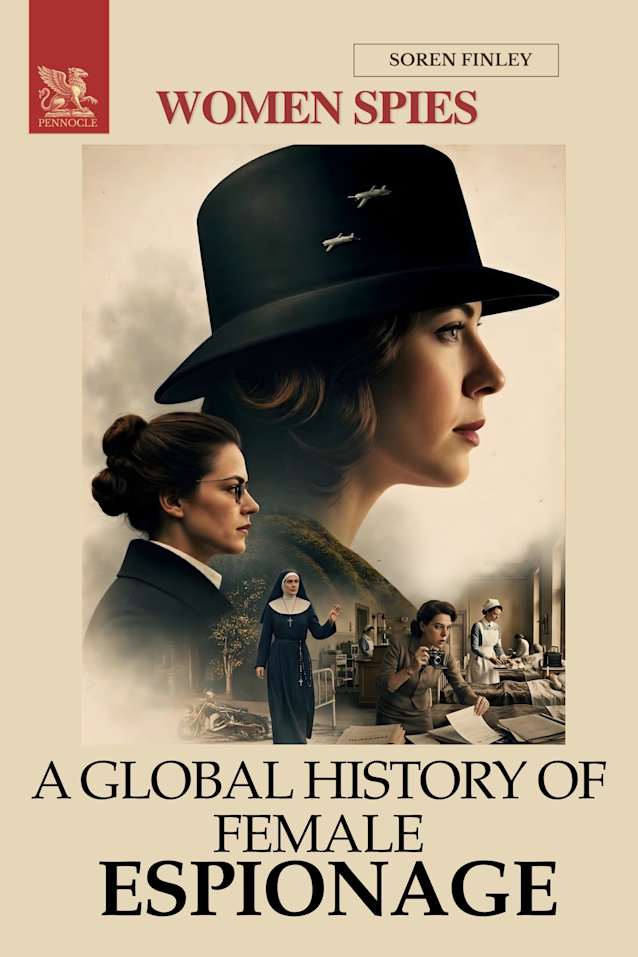
Women Spies
About
Every civilisation discovered the same secret. None learned to defend against it.
In 1488, a woman named Josine Hellebout received a professional salary from the city of Ypres — for military intelligence work. Her existence remained unknown until a single researcher found the evidence in municipal archives in 2022. She is not an exception. Thousands of women operated as intelligence agents across three thousand years of recorded history. Most were erased from the record.
Women Spies examines this pattern at full historical and global scale. In Mauryan India, the Arthashastra codified nine distinct cover identities for female operatives in 300 BCE — with a level of technical precision that Western intelligence thinking would not approach for another two thousand years. In Byzantine Constantinople, palace women organised military coups without ever falling under suspicion. In the Cold War, Ursula Kuczynski ran Soviet atomic espionage networks from an English country cottage while MI5 interviewed her twice and released her both times. She died at ninety-three, never caught.
The book is organised not by era but by the roles women used as covers: the courtesan, the seamstress, the nurse, the secretary, the housewife, the performer, the aristocratic insider, the wife. Within each role, stories are drawn from multiple centuries — and the pattern becomes impossible to dismiss. The same covers. The same blind spots. The same failure of counterintelligence to recognise women as threats. Discovered independently, in every century, on every continent.
Jeannie Rousseau de Clarens extracted the complete specifications of the V-2 rocket from German engineers by performing the role of an unserious girl — intelligence the CIA later described as a masterpiece. Melita Norwood passed British nuclear secrets to Moscow for thirty-seven years, was known to intelligence services for thirty-four of them, and was never arrested. Josephine Baker carried more than fifty classified documents through Lisbon in her sheet music; it never occurred to the Nazi officials around her to search her. Josefina Guerrero’s leprosy became her most effective operational cover — Japanese checkpoint guards recoiled rather than search her, while maps were taped to her back.
The book’s central argument is not that these women were unusually courageous, though many were. It is that gender blindness was a structural vulnerability, built into every counterintelligence system that ever existed. Threat profiles were constructed from the characteristics of agents who had already been caught — who were overwhelmingly male. Women who did not match those profiles were not detected. Women who were not detected left no traces. And the absence of traces reinforced the assumption that there was nothing to find. The logic was circular and the error perpetuated itself across civilisations and centuries.
The most damning proof: the women who succeeded most completely are the ones history knows least about. Their absence from the record is not a gap in the evidence. It is the evidence.
Part of the Espionage series.