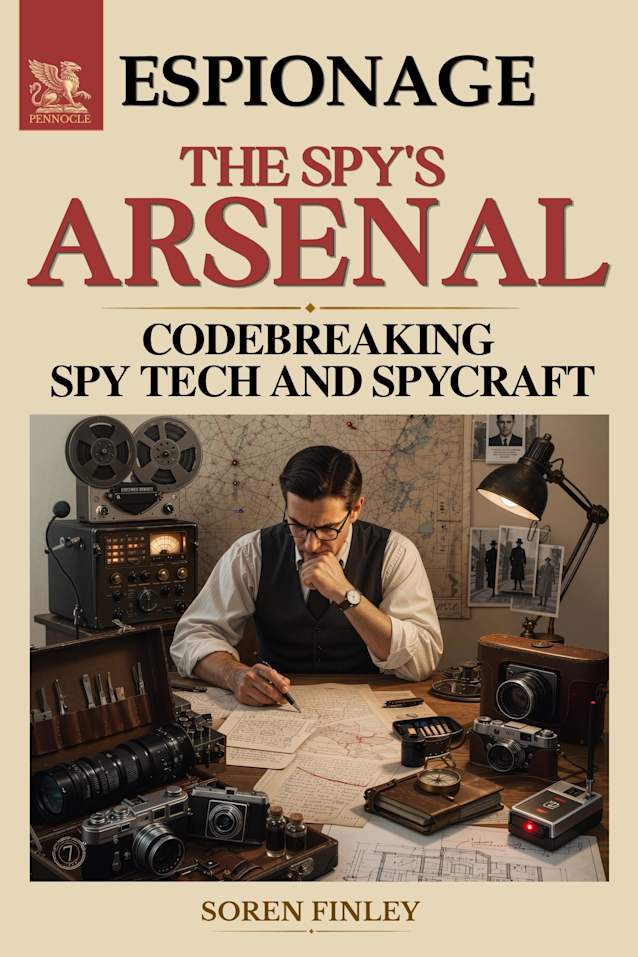
The Spy’s Arsenal: A Global History of Espionage Technology, Codebreaking and Spycraft
About
The services that mastered new technology first won the intelligence war. Those that fell behind lost it.
The Spy’s Arsenal tells the full story of how intelligence services equipped themselves across twenty-five centuries — from the first hidden messages of the ancient world to the artificial intelligence systems that now identify military targets in real time.
The book covers three interconnected domains:
Cryptography and codebreaking — from the Spartan scytale and al-Kindi’s ninth-century invention of frequency analysis through the Enigma machine, the one-time pad, and the quantum-computing threat to all modern encryption. The Polish mathematicians who broke Enigma — Marian Rejewski, Jerzy Różycki, and Henryk Zygalski — receive the full treatment their achievement deserves. They solved the problem six years before Alan Turing arrived at Bletchley Park, using abstract mathematics rather than trial and error, and their contribution remains dramatically underappreciated in Western accounts of the war.
Physical tradecraft — invisible ink from Pliny the Elder to the First World War; concealment devices from hollowed-out coins to the Minox camera; SOE’s wartime gadget laboratory; the Cold War listening device hidden inside a carved wooden seal; the Stasi’s 174,000 informants and their extraordinary smell-sample surveillance archive.
Surveillance and cyber technology — from Leon Theremin’s battery-free bug to Stuxnet’s digital sabotage of Iranian centrifuges, from the Venona project and Operation Rubicon to Pegasus spyware and the AI systems now reshaping modern intelligence.
Twenty-five chapters. Twenty-five centuries. Told through the people and operations that changed the history of intelligence — not as a catalogue of gadgets, but as a history of the ideas, breakthroughs, and failures that determined who won and who lost.