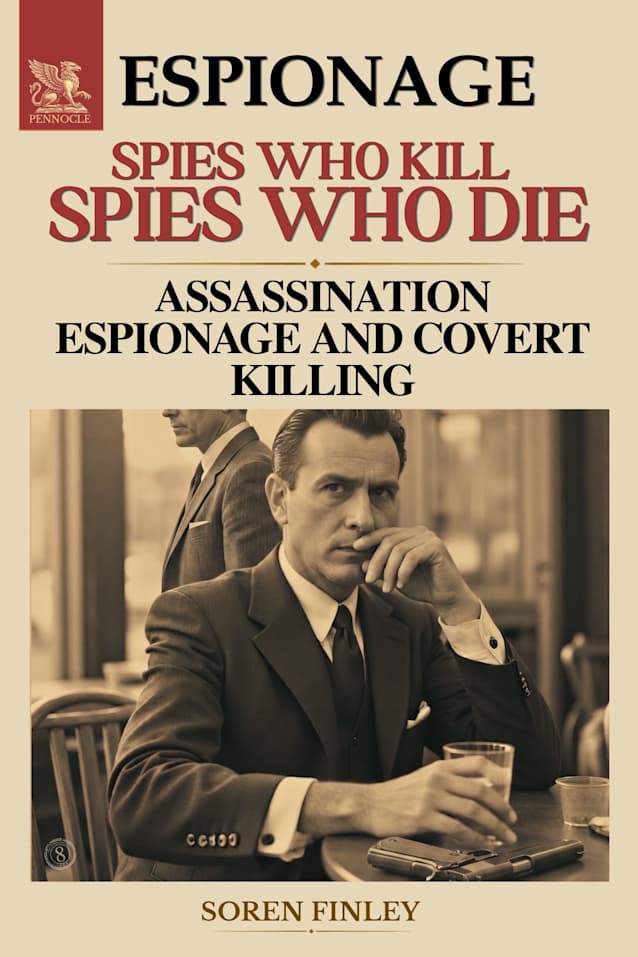
Spies Who Kill, Spies Who Die: The Lethal History of Espionage, Assassination, and Covert Killing
About
They didn’t recruit him. They didn’t turn him. They killed him.
Assassination is the oldest tool in the intelligence trade — and the least understood. For as long as states have gathered secrets, they have also decided, coldly and deliberately, when a human being was too dangerous to leave alive. Spies Who Kill, Spies Who Die is the first truly global history of that decision: who kills, who dies, why states cross the darkest boundary of espionage, and what it costs them when they do.
This is not the Hollywood version. It is the real one — stranger, bloodier, and far more consequential.
From the daggers of the Sicarii in Roman Jerusalem to the exploding pagers of twenty-first-century Lebanon, this sweeping narrative traces a single unbroken thread across 2,500 years:
- The Hashashin — not drugged fanatics, but the most disciplined killing organisation before the modern age, who once left a dagger on a sultan’s pillow instead of in his heart.
- Stalin’s long arm: Trotsky’s ice axe, the strychnine chocolates left beside a murdered defector, and the plague-infected assassin meant for Tito.
- Bogdan Stashinsky, the KGB assassin who killed with a cyanide spray pistol, then defected and exposed the entire Soviet murder machine in open court.
- Mossad’s Wrath of God — and Lillehammer, where a fifteen-agent team shot the wrong man in front of his pregnant wife.
- The CIA’s exploding seashells, poisoned cigars, and Mafia contracts against Castro — every one a failure.
- Litvinenko, Skripal, Navalny: Russia’s century-old poison laboratory, reactivated and unrepentant.
- Kim Jong-nam, killed with VX by two women who thought they were on a prank show.
- The drone age, where a single lawyer’s “death folders” replaced the pistol and the poison.
But this book asks harder questions than any thriller. Does assassination ever actually work — or does it create more enemies than it eliminates? What happens to the men and women who pull the trigger? And the central question that haunts every chapter: can a democracy kill in secret and remain a democracy?
Analytical rather than sensational, global rather than narrowly Western, and honest about what we know and what we cannot, this is intelligence history for readers who want the truth beneath the myth. If you were gripped by Ronen Bergman’s Rise and Kill First, Ben Macintyre’s The Spy and the Traitor, or Tim Weiner’s Legacy of Ashes, this book belongs on your shelf.
Every civilisation that built an intelligence service eventually used it to kill. This is the story of how — and why they keep doing it.
Part of the ESPIONAGE series — a global history of intelligence from antiquity to the present.